AFS and ESN Joint Position on the EU Inc. Proposal

Introductory note
Allied For Startups (AFS) and the European Startup Network (ESN), with support from EU-INC, welcome the proposed EU Inc. regulation as an important first step toward reducing Single Market fragmentation for startups and scaleups.
Today, Europe does not function as a true single market for innovative companies due to fragmentation in company law, administration, and financing. This makes cross-border scaling costly and complex. EU Inc. aims to address this by creating a harmonised baseline framework.
However, it should be seen as a minimum viable product: its success will depend on simplicity, predictability, and trust from founders and investors.
This paper sets out recommendations in three areas: preserving core features, fixing structural risks, and ensuring enforceability.
1. Preserve what works
The proposal’s core features must be maintained:
- Legal form (Regulation, not Directive): avoid national divergence and opt-outs.
- Fast incorporation (48h, €100 cap): must include aligned VAT/TIN processes with binding deadlines.
- Cross-border flexibility: allow separation of HQ, registration, and operations across Member States.
- Digital-by-default: end-to-end digital processes; exceptions must not delay or increase costs.
- EU templates: must fully replace national formalities and include modern startup tools (options, SAFEs, investor rights).
- Flexible financing: no minimum capital; support venture-style instruments (e.g. EU-FAST).
- Once-only principle: seamless data sharing across tax, VAT, UBO, and social security systems.
- Employee stock options (EU-ESO): preserve exit taxation principle and harmonised treatment.
- Lifecycle coverage: fast, digital incorporation and liquidation should be consistent across company life.
2. Fix structural risks
Key risks could reintroduce fragmentation:
- Over-reliance on national law: must remain minimal; avoid governance divergence and dual residency issues.
- Weak EU infrastructure: need interoperability or a central EU registry layer, with real-time data exchange and APIs.
- Uneven implementation: enforce deadlines, simplify requirements, and introduce deemed approval where needed.
- Judicial fragmentation: specialised courts, CJEU referrals, ADR options, and use of English where agreed.
- Incomplete lifecycle coverage: improve cross-border restructuring and insolvency coherence over time.
- Unclear cross-border rules: avoid automatic branch requirements for distributed or remote teams.
3. Ensure enforceability and accountability
EU Inc. must be enforceable in practice:
- Non-discrimination enforcement: EU-level complaint mechanism with short deadlines and real consequences.
- Effective remedies: enforce once-only principle and other core rights through practical tools.
- Monitoring framework: track incorporation time, cost, VAT/TIN speed, uptake, and cross-border consistency.
4. Address key concerns
4.1 Forum shopping
Forum shopping already exists due to fragmentation. A stronger, harmonised EU Inc. would reduce it by increasing predictability and reducing incentives to use non-EU structures.
4.2 Fraud and fast registration
Speed does not equal lower safety. Strong AML/KYC, digital verification, and interoperable systems can ensure both efficiency and security. Minimum capital is not an effective safeguard.
4.3 Employee stock options
Stock options should complement – not replace – fair wages. Harmonised rules can improve competitiveness and cross-border usability without weakening labour protections.
4.4 Worker participation
Existing national participation rights should remain at subsidiary level, but EU Inc. should not impose uniform co-determination at holding level or link governance to seat location.
4.5 Lessons from past EU company law
Previous failures show the risk of either political overreach or impracticality. EU Inc. must remain usable, balanced, and focused on real scaling challenges.
Conclusion
EU Inc. is a major opportunity to reduce fragmentation and strengthen Europe’s startup ecosystem. Its success depends on preserving its core features, avoiding fragmentation risks, and ensuring consistent implementation. It should become a practical, trusted, and widely adopted European company form – not just a symbolic label.
Keeping up with the change
Stay up to date with the latest news, insights, and actions from allied for startups. Discover how we’re working to amplify voices, shape policies, and create opportunities for startups worldwide.
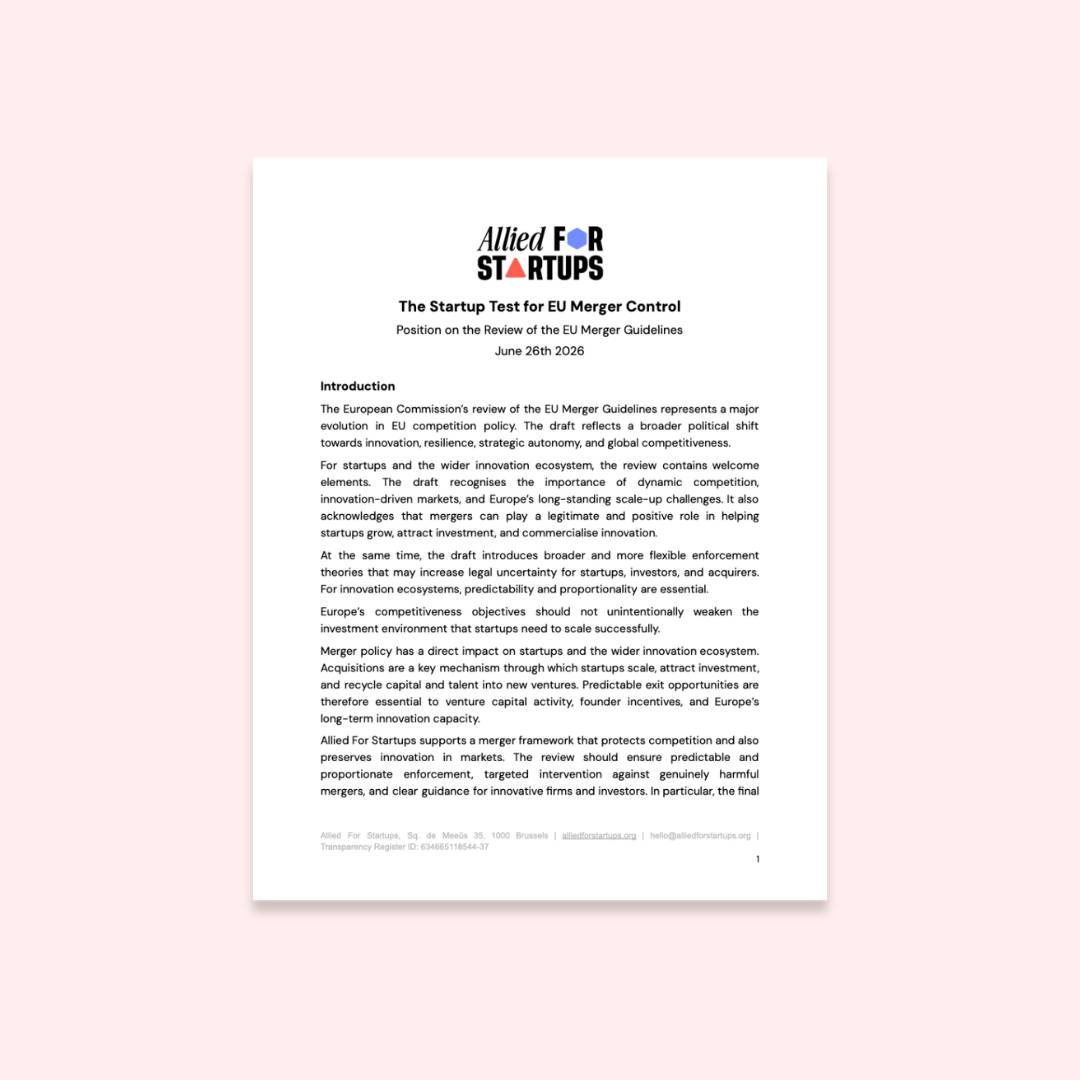
AFS’ Position on the Review of the EU Merger Guidelines
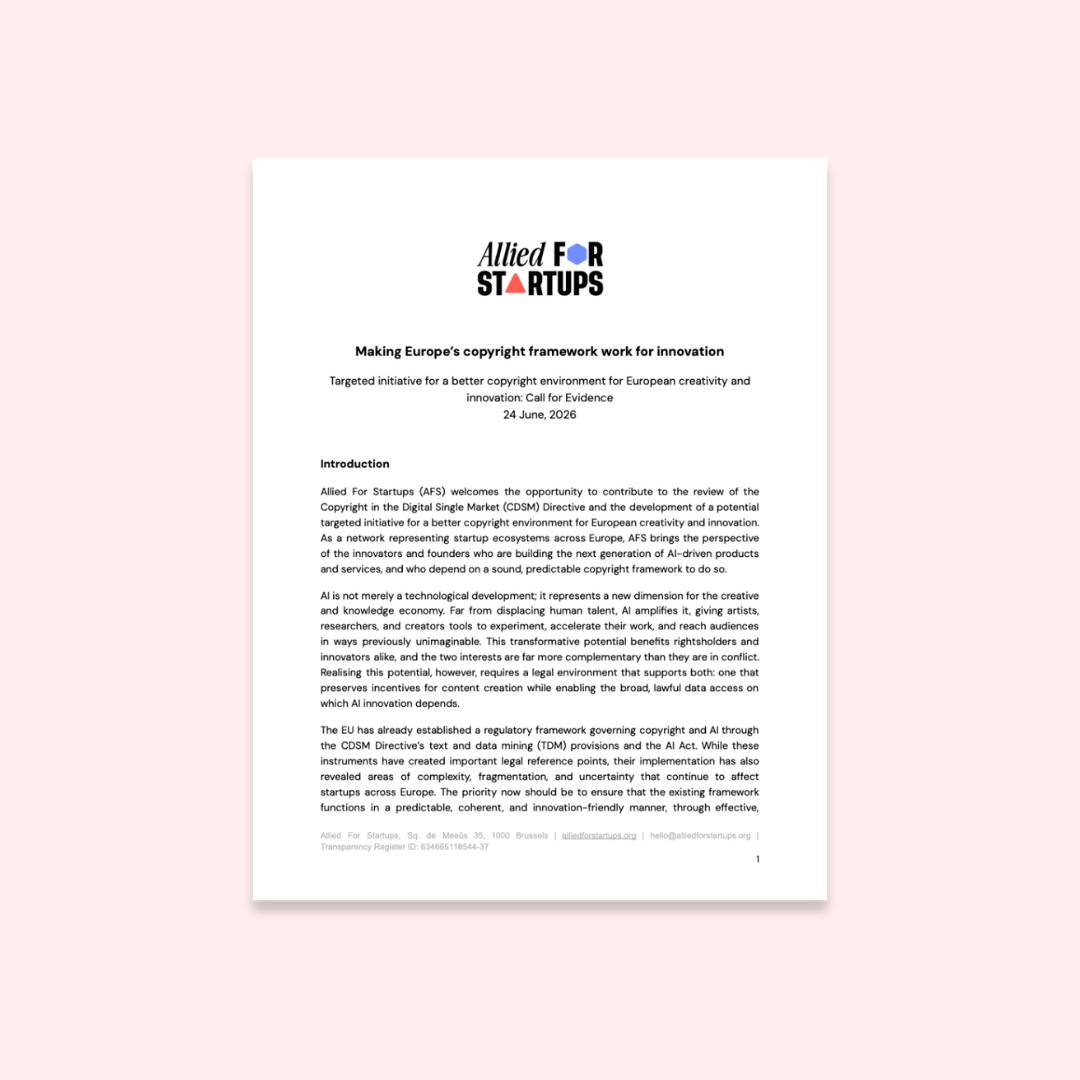
AFS’ Position on the Directive on Copyright in the Digital Single Market
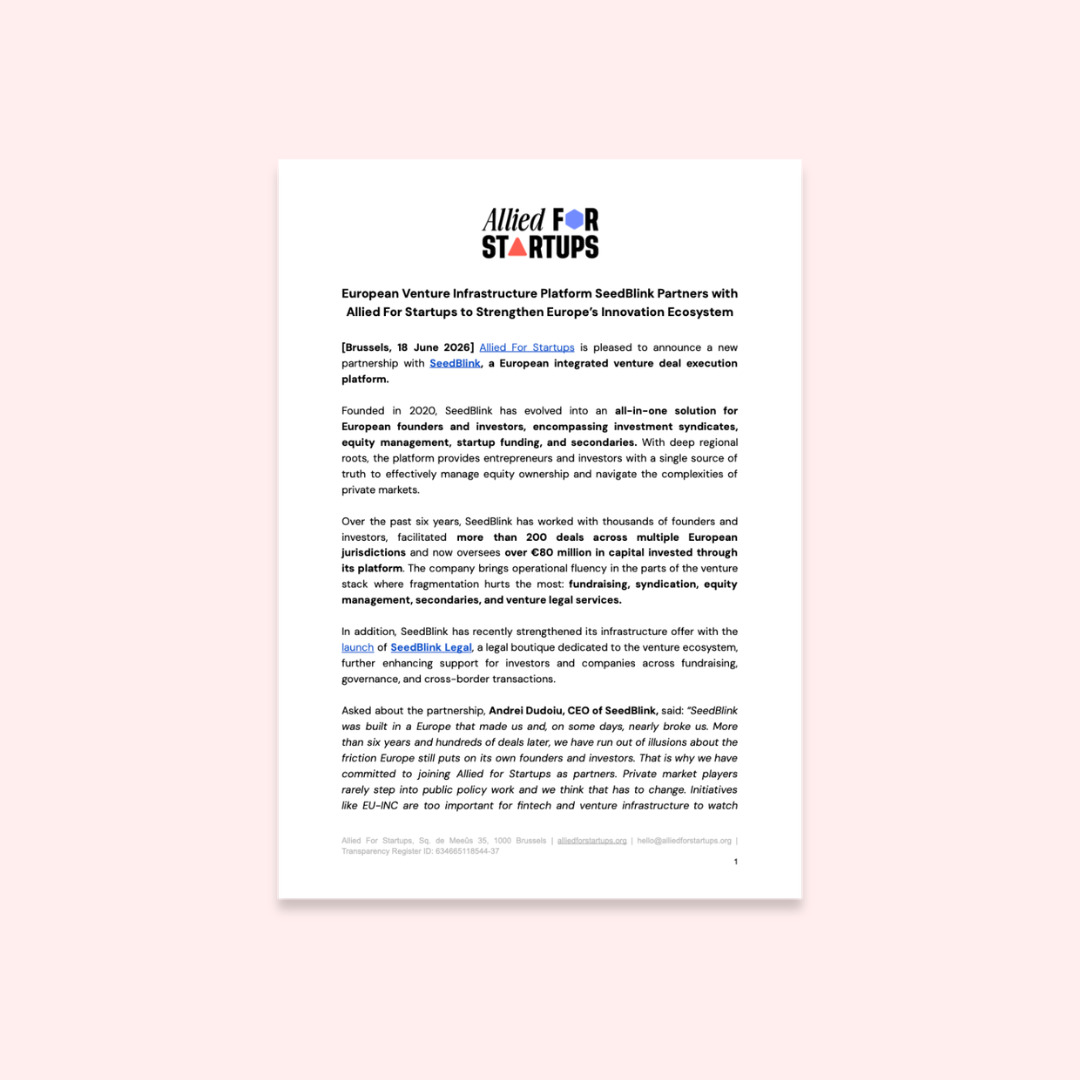
European Venture Infrastructure Platform SeedBlink Partners with Allied For Startups to Strengthen Europe’s Innovation Ecosystem
Startup Innovation
in Action
Join the conversation where policy meets innovation. Allied for Startups brings together entrepreneurs, policymakers, and industry leaders to tackle the biggest challenges and opportunities facing startups today.
Stay Informed
Stay Ahead
Discover how we change the game. Our news and publications offer an inside look at the policy work driving innovation and change in the startup ecosystem.