AFS' First Reaction to the European Commission’s Proposed EU Inc. Corporate Legal Framework

A necessary first step – but a competitive solution?
The European Commission’s proposal for EU Inc., presented as a Regulation, marks a long-awaited step in addressing one of Europe’s most persistent structural challenges: the fragmentation of its Single Market for startups and scaleups.
While Europe offers a market of 450 million people, founders still face 27 different legal systems and a wide range of company forms when starting and scaling a business. In practice, this translates into complex administrative procedures, delays in incorporation, and barriers to operating seamlessly across borders. The result is a system that slows down growth and discourages investment at scale.
In this context, the presentation of a legislative framework is, in itself, an important signal. It reflects a growing recognition that this fragmentation is structural and requires a European-level response.
At the same time, the proposal remains incomplete. Key elements of the regime – such as the EU register and dispute resolution improvements – are deferred to future measures or broader developments, keeping uncertainty at the very moment when clarity and legal certainty are most needed.
On paper, it surely looks European, but in practice it may feel national. EU Inc. must work for startups first as they are Europe’s best strategy to compete globally. Its design choice can determine whether the framework becomes the default for founders and investors, or remains a marginal option.
What the proposal gets right
The proposal introduces a number of meaningful improvements that respond directly to long-standing challenges faced by startups and scaleups in Europe.
The choice of a Regulation provides a stronger basis for harmonisation across Member States, reducing the risk of divergent transposition. The emphasis on digital-by-default processes, including the objective of enabling company creation within 48 hours at low cost and fully online, reflects a clear understanding of the need for speed and efficiency in company formation.
The framework also introduces greater flexibility in corporate structures, including the possibility to use different classes of shares and modern financing instruments that are widely used in venture capital ecosystems. This is a critical step towards aligning European company law with the realities of high-growth startups.
In addition, the proposal seeks to improve conditions for employee participation through stock options and introduces elements aimed at simplifying certain procedures, including liquidation and targeted simplifications in insolvency processes for innovative startups. The move towards taxation of stock options at exit is particularly welcome and could significantly improve talent attraction and retention across the Union.
Taken together, these elements represent a clear effort to modernise the European company law framework and bring it closer to the needs of founders and investors.
A structural limitation at the core of the design
The central question is whether EU Inc., as currently designed, is capable of delivering a truly integrated European company framework in practice.
The new corporate form does not constitute a genuine “28th regime”, detached from national systems. It relies on the interconnection of national legal and administrative systems, with an EU-level interface acting as a common entry point. While the Commission foresees the development of a future central register for EU Inc. companies, this is not part of the system from the outset. In the meantime, the framework depends on existing national registries connected through BRIS.
This sequencing raises a fundamental question. If a central European registry is ultimately recognised as necessary to ensure uniformity and legal certainty, it is not clear why it is postponed rather than embedded as a core component of the regime from day one. A company form designed to operate across the Union should be built on a single, coherent infrastructure at the moment of its creation.
Why this matters for founders and investors
For founders and investors, the value of a European company form lies not only in the existence of common rules, but in the predictability and simplicity of how those rules are applied.
If incorporation processes continue to vary depending on the Member State of registration, if corporate actions still require navigating different administrative practices, or if legal outcomes depend on national interpretation, the framework will struggle to provide the level of certainty that high-growth companies require.
Startups operate in environments where speed, clarity and trust are essential. Investors, in particular, rely on consistent legal frameworks and predictable outcomes when deploying capital across borders. Any residual fragmentation reduces the attractiveness of the regime and creates incentives to rely on alternative jurisdictions that offer greater simplicity and coherence.
The success of EU Inc. will therefore depend on whether it delivers a genuinely uniform experience in practice, rather than a formal layer of harmonisation.
Key areas where the framework needs to be strengthened
Several elements of the proposal illustrate the broader structural challenge and will be critical to its effectiveness.
The approach to company registration is a central example. The proposal relies on the Business Registers Interconnection System (BRIS), which connects national registries through a common interface. While this builds on existing infrastructure, it also inherits its limitations. National registries continue to operate under different procedures and requirements, meaning that the incorporation experience may still vary across Member States. A more robust long-term solution would be the creation of a genuinely European registry for EU Inc. companies, supported by a single digital entry point and real-time data systems, ensuring uniform processes and consistent administrative standards. The Commission itself points in this direction by signalling the development of a future central register. However, the timeline and level of ambition for this remain unclear. If such a registry is considered essential for the proper functioning of the regime, its absence at launch raises important questions about the completeness of the framework. We will be paying close attention to how and when this element is developed, as it will be critical to the credibility and uptake of EU Inc. from the outset.
Dispute resolution raises similar concerns. The proposal leaves the handling of disputes primarily to national courts, which creates a risk of divergent interpretations of the same rules. This would undermine one of the core objectives of the regime: to provide a predictable legal environment for cross-border investment. The Commission encourages Member States to establish specialised national courts or chambers to deal with EU Inc.-related cases, which is a step in the right direction. However, this alone may not be sufficient to ensure consistent interpretation across the Union. Establishing a mechanism at European level, such as a specialised chamber linked to the Court of Justice of the European Union with an efficient referral system, could further strengthen the coherence and credibility of the framework.
Insolvency is another area where fragmentation remains a major obstacle. While startups operate in a high-risk environment where failure is part of the innovation cycle, scaleups also require predictable and efficient restructuring frameworks as they expand across borders. Insolvency regimes across the Union remain slow, complex and highly divergent, creating uncertainty not only in failure scenarios but also in restructuring and recovery. The introduction of simplified and time-bound procedures for innovative startups is a positive step. However, limiting these improvements to early-stage companies risks overlooking the needs of scaleups, which often operate in multiple jurisdictions and face significantly higher operational and financial complexity. A truly effective EU Inc. framework should ensure that fast, efficient and predictable insolvency and restructuring procedures apply across the full growth cycle, enabling companies to adapt, reorganise or wind down seamlessly across borders.
Finally, the framework should fully reflect the operational reality of modern startups. Many companies are digital-first and operate with distributed teams across multiple Member States. EU Inc. should ensure that hiring employees in another Member State, in the absence of a physical establishment, does not trigger additional registration requirements or administrative burdens. It is therefore an important step that the Commission intends to further explore enabling fully cross-border telework for startups and scaleups through the forthcoming Fair Labour Mobility Package.
The path forward
The legislative process now offers a critical opportunity to strengthen the proposal and align it more closely with its original objective.
The European Parliament and Member States have a key role to play in ensuring that EU Inc. evolves into a framework that is not only well-designed on paper, but fully functional in practice. This requires addressing the remaining sources of fragmentation, reinforcing elements that enhance legal certainty, and ensuring that the regime reflects the way startups and scaleups actually operate.
The focus should not be on adding complexity, but on delivering a system that is simple, predictable and efficient enough to become the natural choice for companies operating across Europe.
A decisive moment for Europe’s startup ecosystem
Europe has a clear opportunity to position itself as one of the most attractive places in the world to start and scale a company. Achieving this requires more than incremental improvements. It requires a framework that allows companies to operate across the Union as if it were a single jurisdiction.
EU Inc. has the potential to become that framework. But for it to succeed, it must offer a level of simplicity, coherence and legal certainty that clearly exceeds what is currently available. The real question now is whether EU Inc., as proposed, is sufficiently ambitious to achieve that objective in practice. The test is simple: will founders choose it, and will investors trust it? If the answer is no, then even a well-intentioned framework risks becoming irrelevant in practice.
The question is no longer whether Europe needs a European company form for startups. The question is whether EU Inc., as it moves through the legislative process, will be designed with sufficient ambition to fulfil that role.
Keeping up with the change
Stay up to date with the latest news, insights, and actions from allied for startups. Discover how we’re working to amplify voices, shape policies, and create opportunities for startups worldwide.
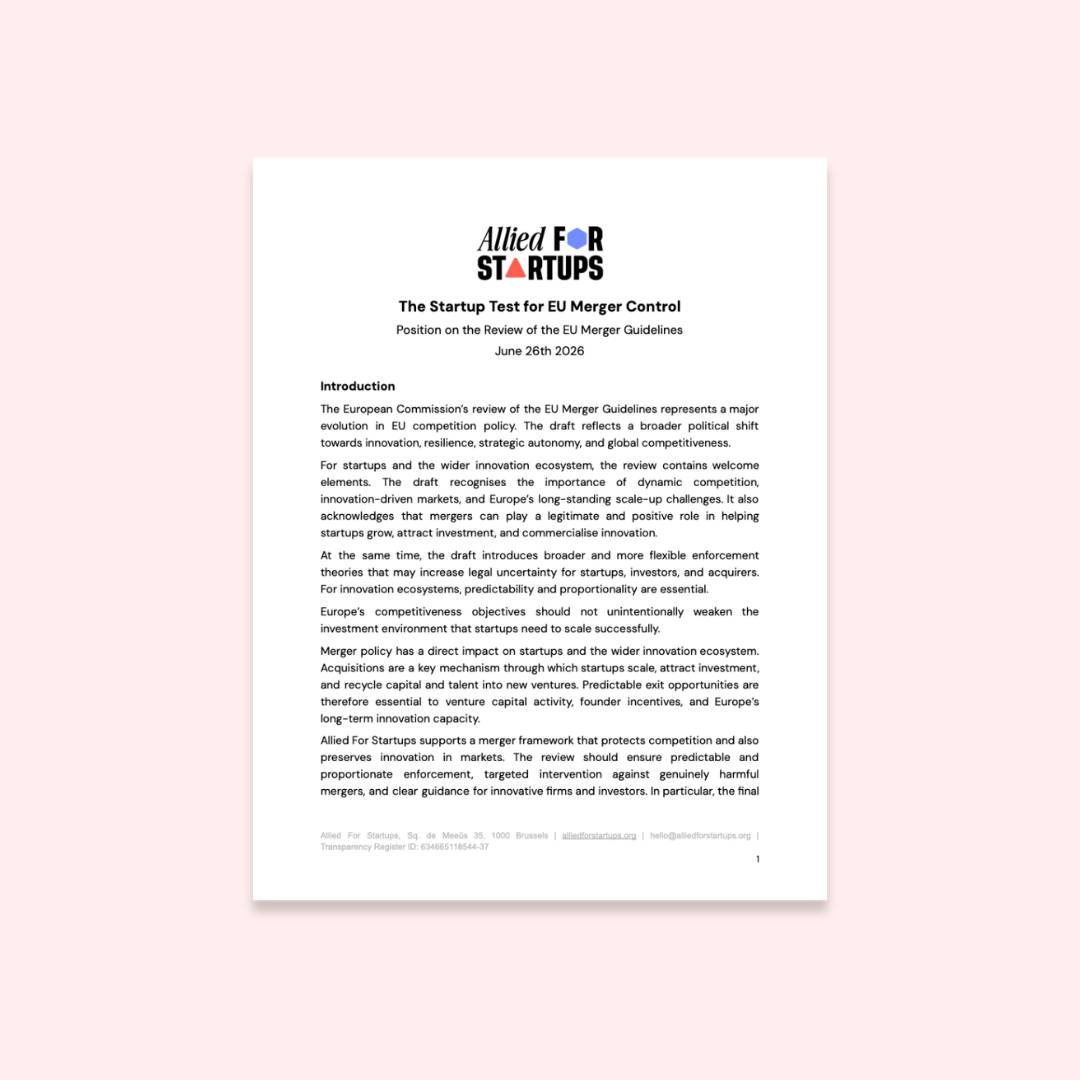
AFS’ Position on the Review of the EU Merger Guidelines
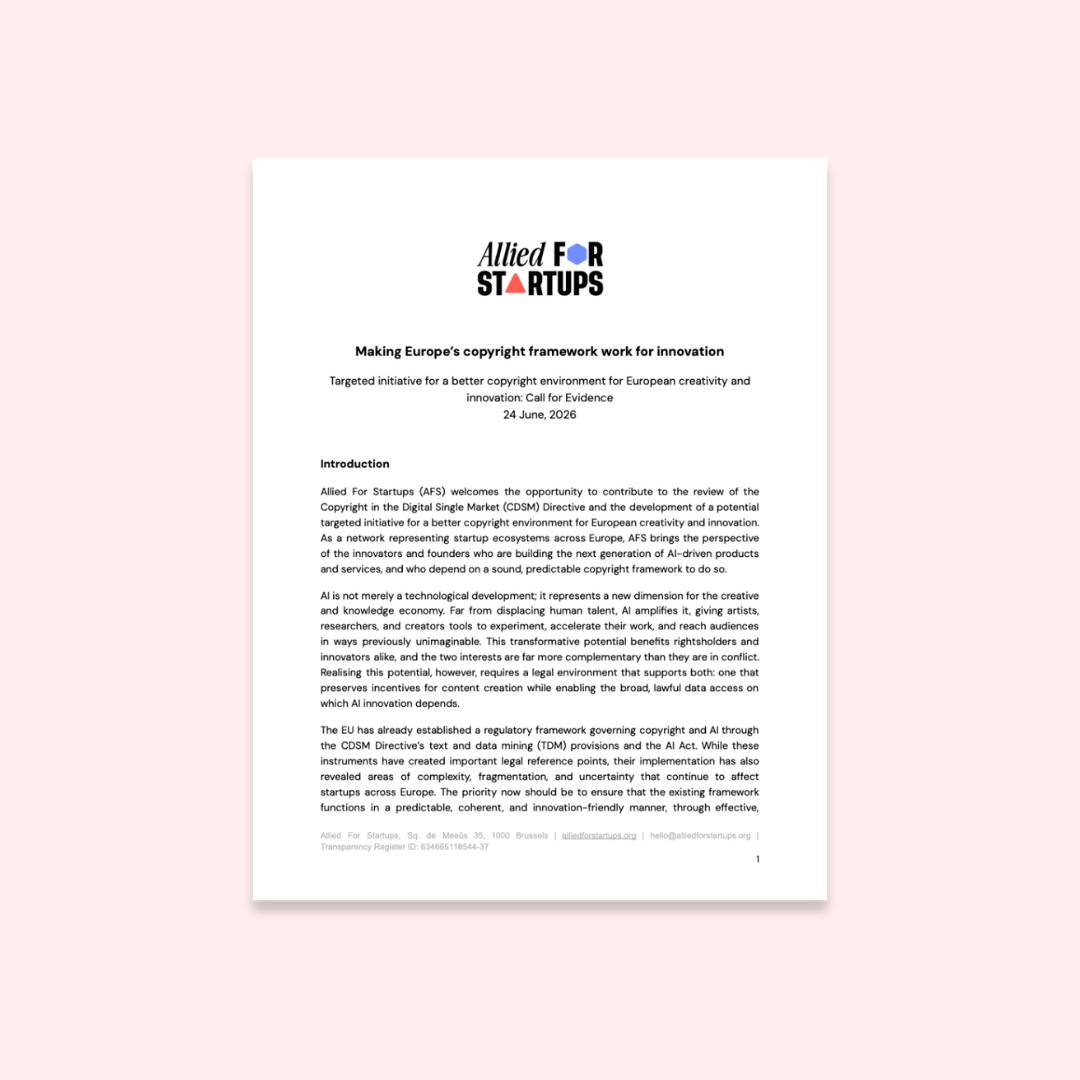
AFS’ Position on the Directive on Copyright in the Digital Single Market
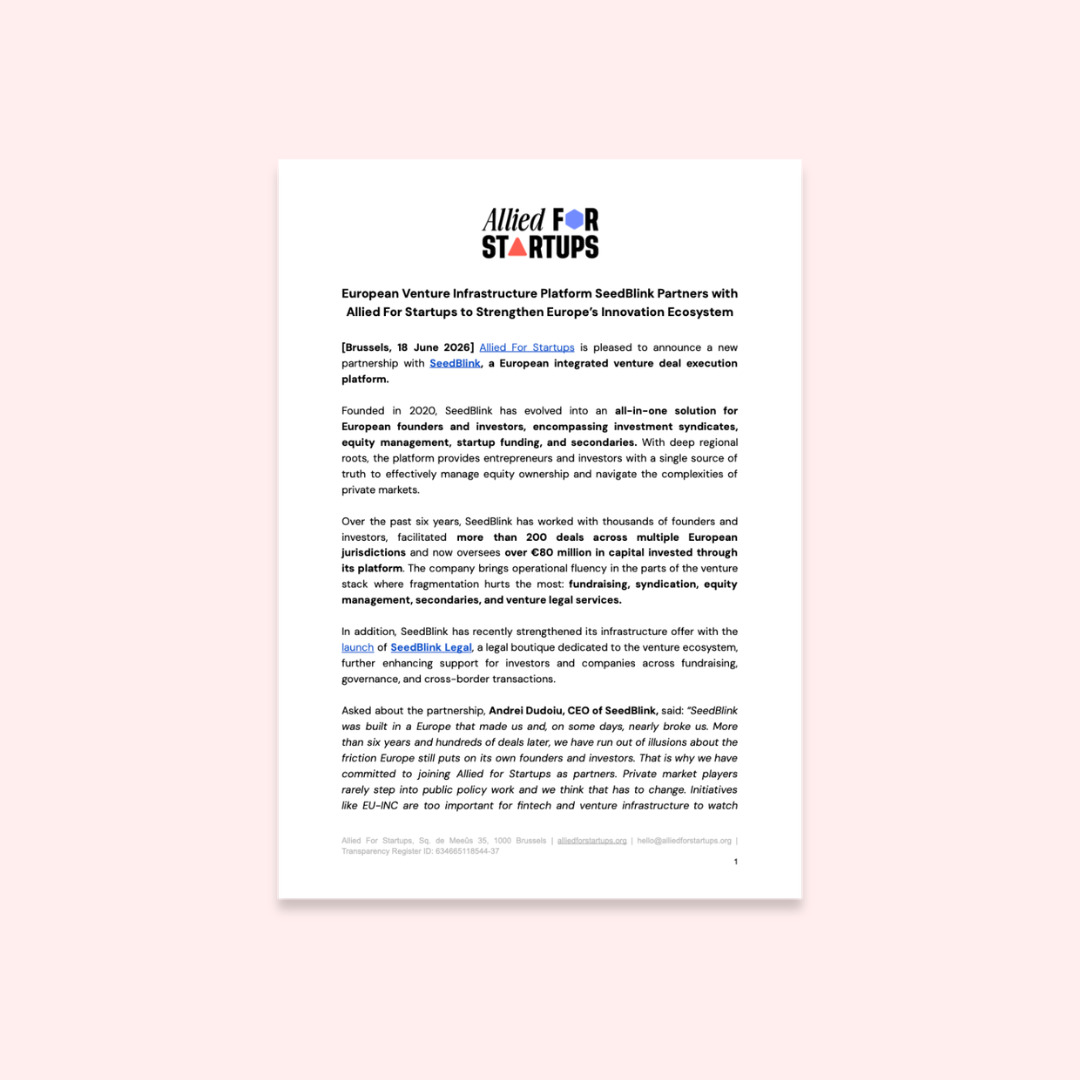
European Venture Infrastructure Platform SeedBlink Partners with Allied For Startups to Strengthen Europe’s Innovation Ecosystem
Startup Innovation
in Action
Join the conversation where policy meets innovation. Allied for Startups brings together entrepreneurs, policymakers, and industry leaders to tackle the biggest challenges and opportunities facing startups today.
Stay Informed
Stay Ahead
Discover how we change the game. Our news and publications offer an inside look at the policy work driving innovation and change in the startup ecosystem.