AFS' Position on the European Venture Capital and Growth Reform
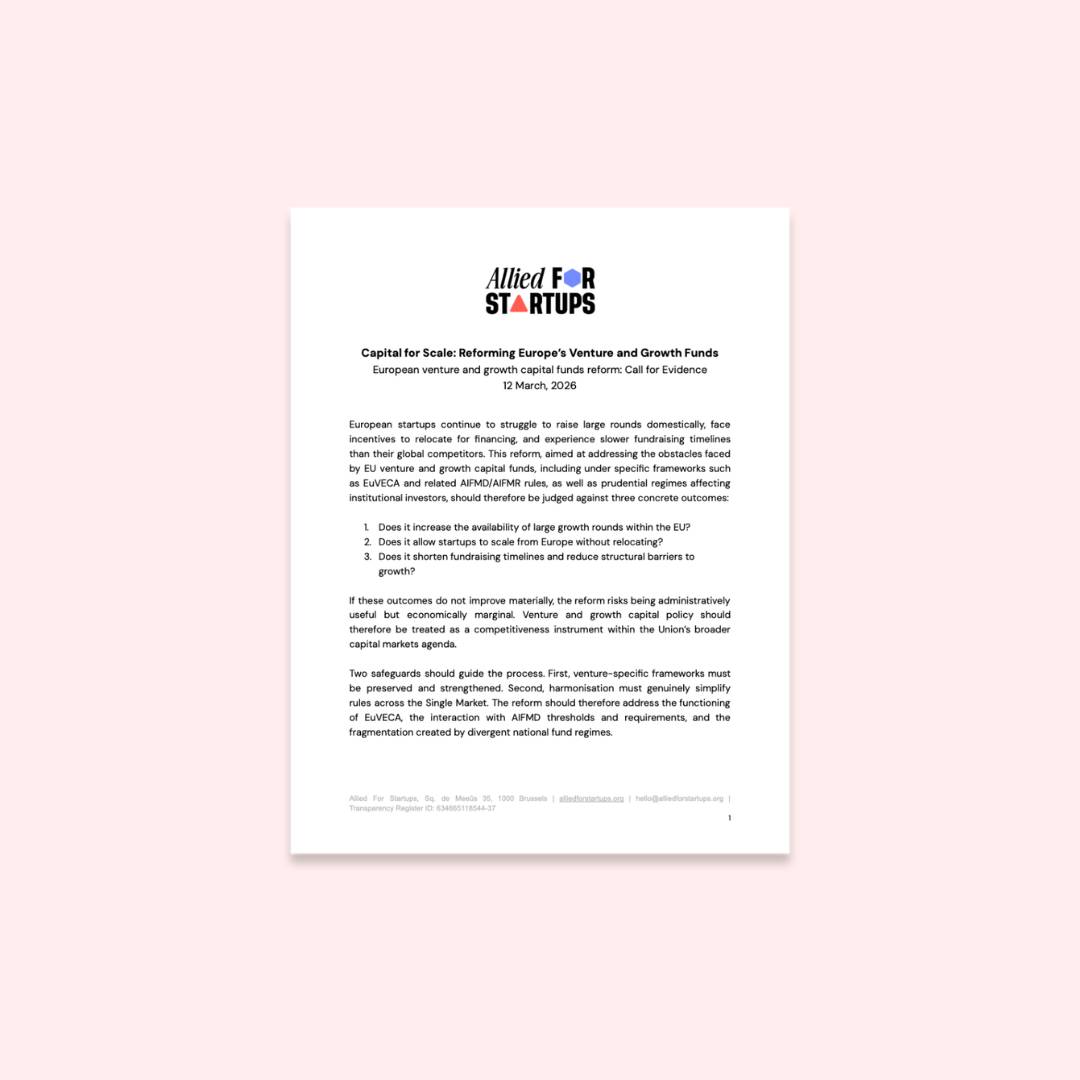
European startups continue to struggle to raise large rounds domestically, often relocate for financing, and face slower, more complex fundraising than global peers.
In our contribution to the European Commission’s Call for Evidence on the reform of European venture and growth capital funds, we outline the key structural barriers that still prevent startups from scaling in Europe – from limited access to large funding rounds to fragmented rules and slow fundraising processes.
For this reform to truly strengthen Europe’s competitiveness, it should be measured against three concrete outcomes:
• Increasing the availability of large growth rounds within the EU
• Enabling startups to scale from Europe without relocating
• Shortening fundraising timelines and reducing cross-border friction
Without measurable improvements in these areas, the reform risks being administratively useful but economically marginal. Venture and growth capital policy should therefore serve as a competitiveness tool within the Union’s broader capital markets agenda.
1. Increasing large growth rounds
Structural rules, particularly under AIFMD, can discourage funds from expanding. Size thresholds alone often penalise venture and growth funds, which typically operate long-term with low leverage and illiquid equity investments. A dedicated “growth corridor” for funds between EUR 500 million and EUR 5 billion would allow managers to raise larger vehicles without sudden regulatory burdens. Institutional investors such as pension funds and insurers are essential to support EUR 50–200 million rounds and long-term scaling partnerships.
2. Allowing startups to scale from Europe
Many high-growth companies relocate their headquarters for financing reasons, not market access or talent. Legal fragmentation, uneven shareholder practices, and cross-border structuring complexity drive this trend. Reforms should improve legal certainty, harmonise fund passports (e.g., EuVECA), and make cross-border fundraising operationally attractive. Success is measured by more startups scaling in Europe rather than leaving.
3. Shortening fundraising timelines
European fundraising is slower due to operational and regulatory complexity. Managers face divergent national procedures, repeated onboarding, and inconsistent supervisory expectations. Streamlined EU marketing passports, harmonised investor rules, and interoperable digital onboarding would reduce duplication, cut structuring costs, and make capital formation faster and more predictable.
4. Preserving and strengthening EuVECA
EuVECA remains one of the few EU instruments focused on venture investment in innovative firms. To increase adoption, the framework should:
- Raise AUM thresholds to accommodate growing managers
- Expand eligible investments to include small mid-caps and SME growth markets
- Simplify institutional investor access
- Align clearly with AIFMD to avoid conflicting obligations
- National gold-plating should be avoided to maintain its EU-wide value.
5. Harmonisation should simplify
EU rules must reduce overall compliance burdens, not duplicate national requirements. Proportionality is critical for smaller and mid-sized managers. Effective harmonisation draws on best practices, lowers cross-border friction, and ensures operational barriers – not complexity – are minimised.
Conclusion
The reform’s value lies in practical outcomes: enabling larger EU-based funding rounds, keeping companies headquartered in Europe, and accelerating capital flows. By strengthening venture-specific frameworks, supporting larger pan-European funds, and ensuring harmonisation delivers real simplification, Europe can better finance innovation at scale and allow its most ambitious companies to grow at home.
Keeping up with the change
Stay up to date with the latest news, insights, and actions from allied for startups. Discover how we’re working to amplify voices, shape policies, and create opportunities for startups worldwide.
AFS’ Position on the Review of the EU Merger Guidelines
AFS’ Position on the Directive on Copyright in the Digital Single Market
European Venture Infrastructure Platform SeedBlink Partners with Allied For Startups to Strengthen Europe’s Innovation Ecosystem
Startup Innovation
in Action
Join the conversation where policy meets innovation. Allied for Startups brings together entrepreneurs, policymakers, and industry leaders to tackle the biggest challenges and opportunities facing startups today.
Stay Informed
Stay Ahead
Discover how we change the game. Our news and publications offer an inside look at the policy work driving innovation and change in the startup ecosystem.