Allied For Startups' Position on the Revision of EU Merger Guidelines
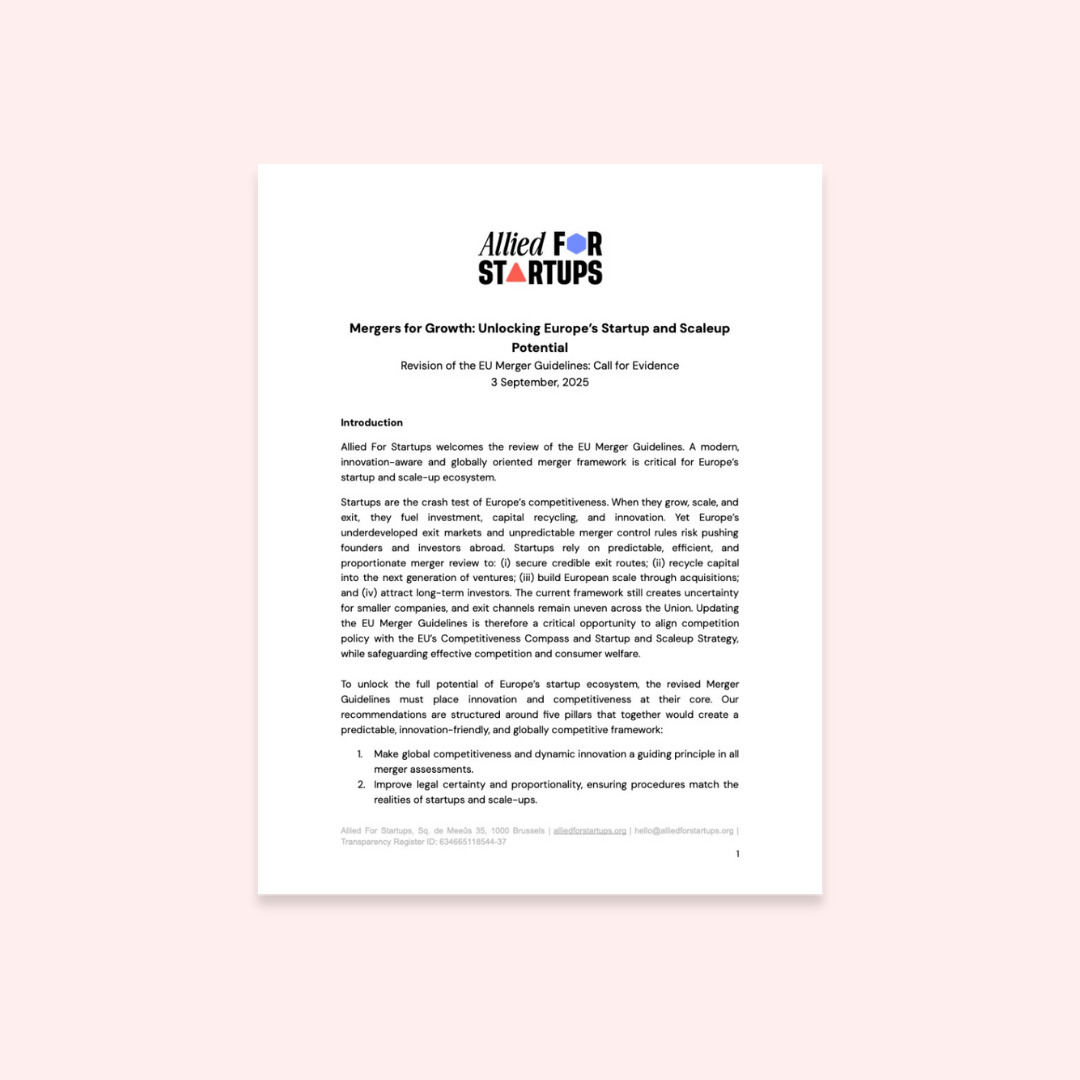
Allied For Startups welcomes the revision of EU Merger Guidelines. A modern, innovation-aware, and globally oriented merger framework is essential for Europe’s startup and scale-up ecosystem.
Startups are a test of Europe’s competitiveness. Their growth, scaling, and exits drive investment, capital recycling, and innovation. Yet underdeveloped exit markets and unpredictable merger rules risk pushing founders and investors abroad. Startups need predictable, efficient, and proportionate merger review to secure exits, recycle capital, grow through acquisitions, and attract long-term investors. The current framework still creates uncertainty for smaller companies, and exit channels remain uneven across the Union. Updating the EU Merger Guidelines is a key opportunity to align competition policy with the EU’s Competitiveness Compass and Startup and Scale-up Strategy, while safeguarding effective competition and consumer welfare.
To unlock Europe’s startup potential, the revised Guidelines must prioritise innovation and competitiveness. Our recommendations focus on five pillars to create a predictable, innovation-friendly, and globally competitive framework:
1. Global competitiveness and innovation as guiding principles
- Explicitly recognise innovation and dynamic competition as drivers of consumer welfare in the Guidelines.
- Incorporate a global market perspective in relevant assessments, especially in sectors where European firms compete with non-EU rivals.
- Avoid static structural tests based solely on market share; focus on forward-looking innovation dynamics.
- Recognise the importance of pro-innovation mergers in strategic sectors such as AI, quantum, biotech, and clean energy, where scale and integration are prerequisites for global competitiveness.
2. Legal certainty and proportionality
- Clarify the scope and timing of Article 22 referrals, ensuring startups and acquirers have foreseeability.
- Avoid speculative or novel theories of harm without clear limiting principles.
- Expand simplified review to cover more startup-related and non-problematic transactions.
- Ensure proportionality in information requests, especially for smaller firms.
- Provide practical self-assessment tools and maintain separate frameworks for horizontal and non-horizontal mergers.
3. Presumption of pro-competitive effects
- Presume mergers are pro-competitive or neutral unless there is clear evidence of harm.
- Limit potential competition concerns to cases where robust, evidence-based analysis demonstrates a realistic and significant threat to competition.
- Revisit the “killer acquisitions” narrative in light of inconclusive evidence, avoiding overly restrictive assumptions.
- Recognise acquisitions as a key incentive mechanism for startup formation and innovation.
4. Recognising vertical and complementary acquisitions
- Maintain separate frameworks for horizontal and non-horizontal mergers to reflect their fundamentally different nature.
- Apply standard foreclosure tests (ability, incentive, effect) rather than speculative theories of harm.
- Streamline reviews of vertical and complementary acquisitions, particularly where startups are involved and time-to-market is critical.
- Explicitly value their role in resilience, innovation, and global scaling, especially in strategic sectors where Europe aims to lead (AI, quantum, biotech, clean energy).
5. Explicitly factoring innovation benefits – an “innovation imperative”
- Create an explicit “innovation imperative” in the Merger Guidelines.
- Apply the same evidentiary standard to efficiencies as to harms, accepting credible claims unless disproven.
- Consider qualitative as well as quantitative evidence, especially in nascent or deep-tech markets.
- Extend the timeframe for assessing efficiencies beyond the typical 3–4 years to capture long-term innovation benefits.
- Recognise out-of-market efficiencies and sustainability benefits as legitimate consumer and societal gains.
Conclusion
Europe’s startups need a merger framework that fosters innovation, investment, and global competitiveness. Modernising the Guidelines to provide predictable, proportionate rules and recognise innovation benefits will make Europe a more attractive place to grow and exit companies. Allied For Startups remains committed to providing insights on merger control’s impact on Europe’s innovation economy.
Keeping up with the change
Stay up to date with the latest news, insights, and actions from allied for startups. Discover how we’re working to amplify voices, shape policies, and create opportunities for startups worldwide.

A Global AI Video Leader, Synthesia, Partners with Allied For Startups to Strengthen Europe’s Innovation Ecosystem

A Global HR Leader, Deel, Partners with Allied For Startups to Strengthen Europe’s Startup Ecosystem
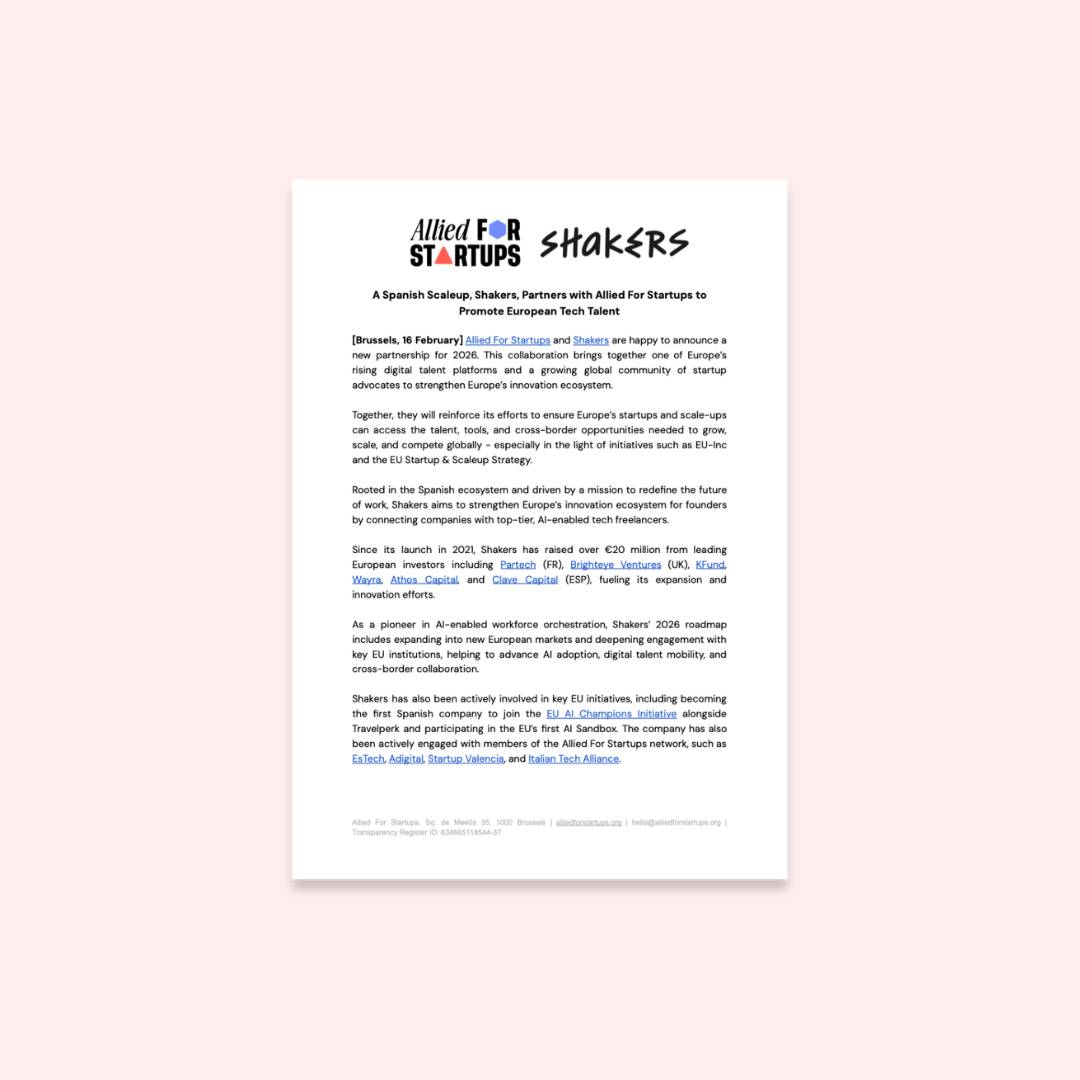
A Spanish Scaleup, Shakers, Partners with Allied For Startups to Promote European Tech Talent
Startup Innovation
in Action
Join the conversation where policy meets innovation. Allied for Startups brings together entrepreneurs, policymakers, and industry leaders to tackle the biggest challenges and opportunities facing startups today.
Stay Informed
Stay Ahead
Discover how we change the game. Our news and publications offer an inside look at the policy work driving innovation and change in the startup ecosystem.